

Customer Benefits
Helps minimize operating costs
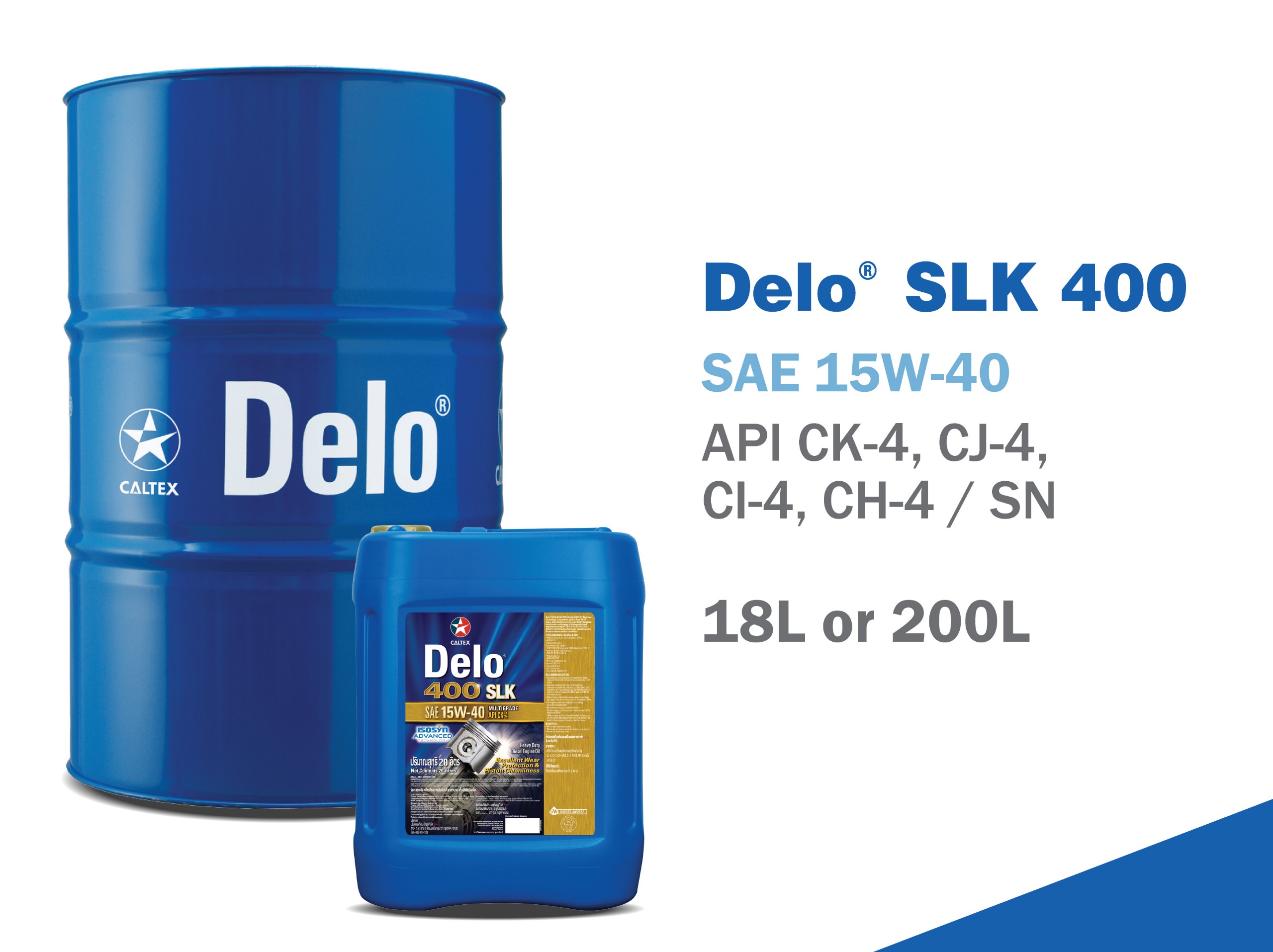
Delo® 400 SLK is designed to provide exceptional soot dispersancy to help keep soot in suspension, and to assist with minimizing filter plugging, cylinder head sludge, abrasive polishing wear and oil thickening. It is formulated with an effective antiwear additive system to help provide robust wear and corrosion protection of engine components, helping to improve equipment durability and reliability while reducing equipment downtime.
Formulated to help maintain emission control system performance
Low Sulfated Ash, Phosphorous and Sulfur (SAPS) technology, helps maximize the life of sensitive catalyst metals and extend the cleaning intervals of diesel particulate filters (DPFs).
Helps reduce inventory costs
Proprietary formulation is designed to provide excellent overall performance in mixed fleets of different engine designs (including modern low emission diesel engines), allowing one oil for many services and helping reduce the chance of product misapplication. Backward compatible with previous API Oil Service Categories and engine models. Please refer to owner’s manual for more details.
Applications
- Commercial road transport, including latest-generation engines fitted with exhaust emissions control devices of all types
- Vehicles meeting the most recent exhaust emissions standards, including US EPA 2002, 2007 and 2010, 2017 greenhouse gas (GHG 17) Euro IV, V and VI, and Australian ADR 80/02 and ADR 80/03 (for heavy duty)
- Mixed fleets of both old and new equipment from many European, North American and/or Japanese OEMs
- Stop-and-go vehicles in high soot loading service such as buses and waste collection trucks
- Most light duty vehicles with diesel engines
- Off-highway vehicles and plants including agricultural equipment
- Many heavy-duty gas-fueled vehicles
- Mobile hydraulic systems (where oil type and viscosity are appropriate)
- Diesel engines utilizing diesel fuels with up to 20% biodiesel (B20)
Product approvals, performance and recommendations
| DELO® 400 SLK | SAE 10W-30 | SAE 15W-40 |
|---|---|---|
| Cummins CES 20086 | Approved | Approved |
| Daimler Trucks DTFR 15C100 (previously MB 228.31) | Approved | Approved |
| Detroit Diesel (Daimler Truck) 93K222 | Approved | Approved |
| Deutz DQC III-18 LA | – | Approved |
| MAN Truck & Bus (Traton) M 3775 | Approved | Approved |
| MTU Category 2.1 | Approved | Approved |
| Volvo VDS-4.5 | Approved | Approved |
| Mack EOS-4.5 | Approved | Approved |
| Renault VI RLD-3 | Approved | Approved |
| ZF TE-ML 04C | – | Approved |
| API CK-4/CJ-4/CI-4/CH-4/CI-4 PLUS/SN | Approved | Approved |
| ACEA E11 | Meets requirements | Meets requirements |
| Caterpillar ECF-3 | Meets requirements | Meets requirements |
| Ford WSS-M2C171-F1 | Meets requirements | Meets requirements |
| JASO DH-2 | Meets requirements | Meets requirements |
Service considerations
“Low SAPS” engine oils tend to have lower Base Numbers than “conventional” heavy duty diesel engine oils. Used in conjunction with today’s low, very low or ultra-low sulfur content fuels this is of no consequence. However, in situations where very high sulfur (>0.5%) fuels are in use this may limit achievable drain intervals. Fuel sulfur levels have declined significantly over the past decade but are still relatively high in some countries, so short drain intervals are recommended. Speak to a Caltex Technical Representative for more information. For applications where fuel sulphur is higher, other products from the Caltex Range like Delo® 400 MGX SAE 15W-40 are recommended.
While the level of phosphorus is low by heavy duty diesel engine oil standards, it is somewhat higher than permitted by certain recent standards for passenger car motor oils, e.g. ILSAC GF-5, and the ACEA “C” standards. Always use the oils listed in the performance standard recommended by the vehicle manufacturer to improve the life of the catalytic emission control systems.
When using with bio-diesel blended fuel meeting ASTM D7467 (B6 – B20) or equivalent it is critical to monitor the engine oil level and performance.
When using with biodiesel blends containing >7% B100, monitoring oil condition is critical. Fuels with higher biodiesel content increase the risk of fuel dilution in the engine oil. This reduces the oxidation stability of the engine oil as biodiesel tends to oxidise more rapidly thus directly impacting the oil drain intervals. Biodiesel contents greater than B7 have a lower energy content than diesel fuel, which may result in slight horsepower loss and slightly increased fuel consumption.
Always follow OEM recommendation for appropriate fuel and engine oil selection.
Typical Test Data
| DELO® 400 SLK | TEST METHOD | RESULTS | |
|---|---|---|---|
| SAE GRADE | 10W-30 | 15W-40 | |
| Product Code | 505503 | 505502 | |
| Base No., mg KOH/g | ASTM D2896 | 8.1 | 8.5 |
| Sulphur, m% | X-ray/ICP | 0.3 | 0.32 |
| Sulfated Ash, m% | ASTM D874 | 0.9 | 1.0 |
| Kinematic Viscosity, | |||
| mm2/s @ 40°C | ASTM D445 | 77.8 | 107 |
| mm2/s @ 100°C | ASTM D445 | 11.7 | 14.7 |
| Viscosity Index | ASTM D2270 | 144 | 141 |