
Quick Answer
Diesel Exhaust Fluid (DEF) is a non-hazardous solution of 32.5% high-purity urea and 67.5% deionized water used in diesel vehicles equipped with Selective Catalytic Reduction (SCR) systems. It reduces harmful nitrogen oxide (NOx) emissions by up to 90%, helping diesel vehicles meet modern emission standards such as Euro 5 and Euro 6. DEF is also known as AdBlue in Europe or AUS 32 under ISO 22241.
What Is Diesel Exhaust Fluid (DEF)?
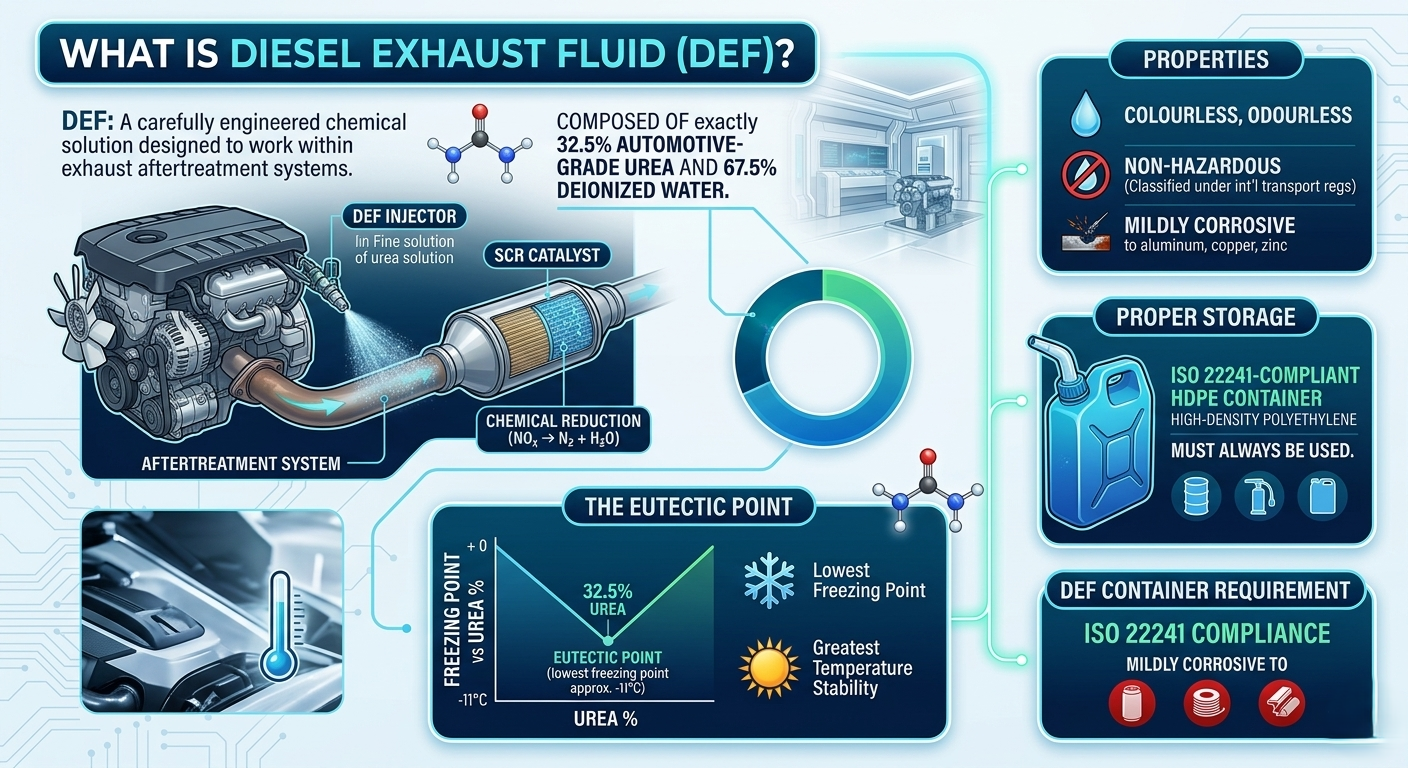
Diesel Exhaust Fluid commonly abbreviated as DEF, is a carefully engineered chemical solution designed to work within the exhaust aftertreatment systems of modern diesel engines. It is composed of exactly 32.5% automotive-grade urea and 67.5% deionized water. This specific ratio is not arbitrary; it represents the eutectic point of the urea-water mixture, meaning it offers the lowest possible freezing point (approximately −11°C) and the greatest stability across a range of temperatures.
DEF is colourless, odourless, and classified as non-hazardous under international transport regulations. It is, however, mildly corrosive to certain metals including aluminium, copper, and zinc. This is why proper ISO 22241-compliant containers made of high-density polyethylene (HDPE) must always be used for storage and dispensing.
DEF vs AdBlue vs AUS 32 — What's the Difference?
These three terms refer to the same product. DEF is the North American term. AdBlue is a registered trademark of the German Association of the Automotive Industry (VDA) used in Europe. AUS 32 (Aqueous Urea Solution 32.5%) is the ISO 22241 technical designation. All three must meet the same purity and concentration standards to be used in SCR systems.
How Does Diesel Exhaust Fluid Work?
Understanding how DEF works requires a basic understanding of the Selective Catalytic Reduction (SCR) system, which is the technology that makes DEF useful. Here is a step-by-step breakdown of the chemical process:
1
DEF Is Injected Into the Exhaust Stream
A metered amount of DEF is sprayed by a dosing injector directly into the hot exhaust gases flowing from the engine. The amount injected is precisely controlled by the engine’s Electronic Control Unit (ECU) based on engine load, speed, and exhaust temperature.
2
Thermolysis — DEF Breaks Down Into Ammonia
The intense heat of the exhaust (typically between 180°C and 600°C) causes the urea in DEF to undergo thermolysis, breaking down into ammonia (NH₃) and carbon dioxide (CO₂). The ammonia is the active agent in the emission-reduction reaction.
3
Catalytic Reaction in the SCR Catalyst
The ammonia then enters the SCR catalyst, a honeycomb-structured unit coated with catalytic materials. Inside the catalyst, the ammonia reacts with the harmful nitrogen oxides (NOx) from the exhaust gases in a controlled chemical reaction.
5
Clean Exhaust Exits the Tailpipe
The treated exhaust gas now with up to 90% less NOx exits the tailpipe. An Ammonia Slip Catalyst (ASC) at the end of the system ensures that any unreacted ammonia is also neutralized before it can escape into the atmosphere.
4
NOx Is Converted to Harmless Gases
The reaction produces diatomic nitrogen (N₂), the inert gas that makes up 78% of the air we breathe and water vapour (H₂O). Both of these byproducts are completely harmless, meaning DEF converts toxic pollutants into the same gases already present in clean air.
Why DEF Is Important for Malaysian Operators
Malaysia has been progressively implementing Euro 5 emission standards for new commercial vehicles. As the country’s vehicle fleet ages, a growing percentage of operational trucks and buses will be SCR-equipped, making a reliable DEF supply increasingly critical for fleet operators across the Klang Valley, Penang, Johor Bahru, and beyond.
Protecting Your Engine and SCR System
Modern SCR-equipped engines are engineered to assume DEF is always available. When DEF levels drop below a critical threshold, the vehicle’s Engine Control Unit (ECU) activates a warning cascade:
- First warning light at approximately 10% tank remaining
- Audible alerts and reduced torque at approximately 5%
- Speed restriction to around 20–30 km/h when DEF runs out completely
- Vehicle may not restart after engine is switched off (varies by manufacturer)
These restrictions are legally mandated by emission regulations and cannot be bypassed without specialized equipment and significant legal consequences.
Financial Impact of DEF Neglect
Ignoring DEF requirements can have severe financial consequences for fleet operators. SCR catalyst replacement can cost thousands of ringgit, and vehicles that fail road-worthiness emission tests face fines and being taken off-road. The cost of maintaining DEF supply is, by comparison, a minor operational expense.
Proper DEF Storage in Malaysia's Climate
Malaysia’s tropical climate was characterised by year-round heat, high humidity, and intense UV radiation. This will poses specific challenges for DEF storage that operators must understand and plan for.
DEF is formulated to be stable between −11°C and 30°C. While freezing is not a concern in Malaysia, heat degradation is a real risk. When DEF is stored above 30°C for extended periods, the urea can break down and the concentration can shift outside the acceptable 31.8%–33.2% range. Degraded DEF will trigger the SCR system’s quality sensor and generate a fault code.
Container Requirements
DEF will corrode and contaminate itself in the wrong container. Here are the rules every operator must follow:
- Use only High-Density Polyethylene (HDPE) or stainless steel (316L) containers
- Never use aluminium, copper, zinc, or carbon steel containers — DEF will react with them
- Dedicated DEF dispensing equipment must never be shared with other fluids
- Always use purpose-made DEF dispensing nozzles — the filler neck on most vehicles is smaller than standard diesel nozzles to prevent misfuelling
- Keep containers sealed when not in use to prevent atmospheric contamination
How Much DEF Does a Diesel Vehicle Use?
DEF consumption is proportional to engine load and NOx output. As a practical guide for Malaysian operators:
| Vehicle Type | DEF : Diesel Ratio | Approx. DEF per 1,000 km | Typical DEF Tank Size |
|---|---|---|---|
| Heavy-duty prime mover / truck | 4–6% | 8–14 litres | 45–75 litres |
| Medium commercial lorry | 3–5% | 5–9 litres | 20–40 litres |
| Bus / coach | 3–5% | 6–10 litres | 30–60 litres |
| Light commercial vehicle | 2–4% | 2–5 litres | 10–20 litres |
| Construction machinery | 2–6% | Varies by workload | 10–50 litres |
Why Choose Our Diesel Exhaust Fluid
At HS Diesel Malaysia, we supply high-quality AdBlue, ensuring your vehicles and machinery operate efficiently while meeting emission standards. Our diesel exhaust fluid is:
- ISO 22241-compliant products with full traceability
- Trusted multi-brand portfolio (Caltex/Delo)
- Flexible supply for all fleet sizes (10L to 1,000L IBCs)
- Proper Malaysia-climate storage & handling protocols
- Expert technical advice on SCR systems
- Strategic Northern Malaysia location (Butterworth, Penang)
- Long-term partnership approach
- Competitive, transparent pricing
Conclusion
Choosing the right DEF supplier is as important as choosing the right DEF product. At Hong Seng Diesel, we serve fleet operators, workshops, and industrial clients across Penang and Northern Malaysia with a comprehensive range of commercial lubricants and diesel-related products. Our team understands the operational demands of Malaysian road transport and can help you build a reliable DEF supply programme tailored to your fleet size and routes.
Frequently Asked Questions (FAQs)
What happens if I run out of DEF?
Modern diesel vehicles with SCR systems are programmed to progressively reduce engine power and torque when DEF levels are critically low, eventually restricting the vehicle to very low speeds or preventing engine restart.
Can I use water instead of DEF?
No. Never use water as a substitute for DEF. The SCR system requires the precise 32.5% urea concentration to function correctly. Using water will trigger the SCR quality sensor fault, fail to convert NOx, and over time cause irreversible damage to the SCR catalyst requiring expensive replacement.
Is DEF the same as AdBlue?
Yes. AdBlue is a registered trademark used in Europe for DEF that meets ISO 22241 standards. In North America it is called DEF, and the ISO technical designation is AUS 32 (Aqueous Urea Solution 32.5%).
How long does DEF last in storage?
When stored correctly, DEF typically has a shelf life of up to 12 months. It should be stored in sealed containers and kept between −11°C and 30°C to maintain proper chemical stability and concentration.
Where can I buy AdBlue or DEF in Malaysia?
You can purchase Diesel Exhaust Fluid (DEF) from Hong Seng Diesel, high‑quality ISO 22241‑certified aqueous urea solution that meets emission standards and keeps your SCR‑equipped vehicles running efficiently.
Disclamer:
We hope you found this article informative. The content provided is for general informational purposes only and does not constitute professional advice or necessarily reflect the full scope of services offered by Hong Seng Diesel Sdn. Bhd.
Readers are encouraged to consult with a qualified industry professional or contact our team for solutions tailored to their specific operational or business needs. While we strive to ensure accuracy and completeness in our articles, we cannot guarantee they are entirely error-free. Hong Seng Diesel Sdn. Bhd. assumes no responsibility for any errors or omissions.